Part No .:
D2764AManufacturer:
IntelDescription:
ICRemark:
new originLast Updated:
2026/10/27
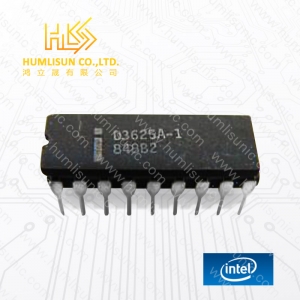
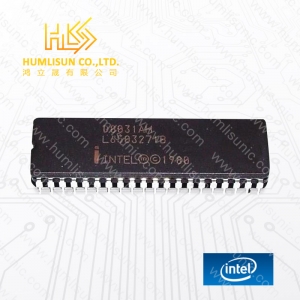
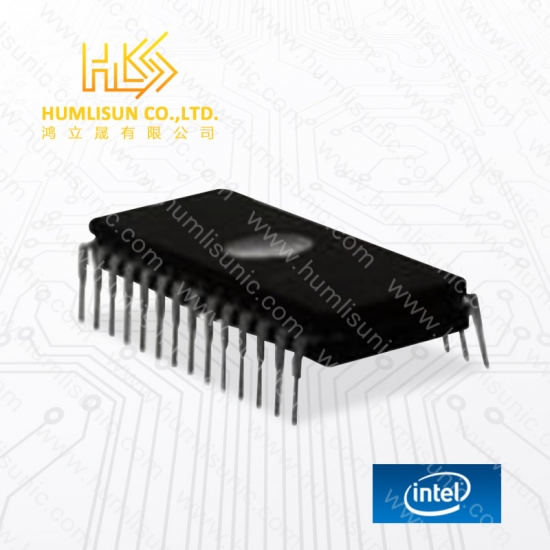
The Intel M2764A is a 5V only, 65,536-bit ultraviolet erasable and electrically programmable readonly memory (EPROM). The M2764A is an advanced version of the M2764 and is fabricated with Intel’s HMOSII-E technology which significantly reduces die size and greatly improves the device’s performance, power consumption, reliability, and producibility. The M2764A also offers reduced power consumption compared to the M2764. The maximum active current is 100 mA while the maximum standby current is only 40 mA. The standby mode lowers power consumption without increasing access time.
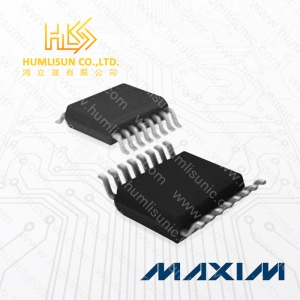
Data sheet Physical Case/Package TSSOP Mount Surface Mount Number of Pins 16 Technical Max Dual Supply Voltage 20 V Max Operating Temperature 70 °C Max Power Dissipation 842 mW Max Supply Current 200 µA Max Supply Voltage 36 V Min Dual Supply Voltage 4.5 V Min Operating Temperature 0 °C Min Supply Voltage 4.5 V Nominal Supply Current 5 µA On-State Resistance 10 Ω Operating Supply Voltage 18 V Supply Type Single , Dual Throw Configuration SPST Turn-Off Delay Time 235 ns Turn-On Delay Time 275 ns Compliance Lead Free Lead Free Radiation Hardening No RoHS Compliant Maxim’s MAX312/MAX313/MAX314 analog switches feature low on-resistance (10Ω max) and 1.5Ω on-resistance matching between channels. These switches conduct equally well in either direction. They offer low leakage over temperature (2.5nA at +85°C). Low power consumption and ESD tolerance greater than 2000V per Method 3015.7 are guaranteed. The MAX312/MAX313/MAX314 are quad, singlepole/single-throw (SPST) analog switches. The MAX312 is normally closed (NC), and the MAX313 is normally open (NO). The MAX314 has two NC switches and two NO switches. All three devices operate from a single supply of +4.5V to +30V or from dual supplies of ±4.5V to ±20V. Applications: Test Equipment Communication Systems PBX, PABX Systems Audio Signal Routing Avionics Sample-and-Hold Circuits Data Acquisition Systems
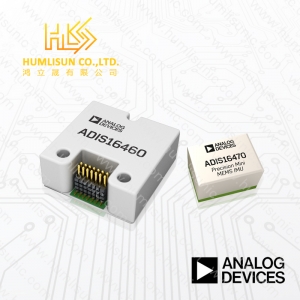
Data sheet Physical Case/Package Module Number of Pins 14 Technical Max Operating Temperature 85 °C Min Operating Temperature -25 °C Output Type SPI Sensor Type Accelerometer , Gyroscope , 6 Axis , Temperature Compliance Lead Free Contains Lead The ADIS16460 iSensor® device is a complete inertial system that includes a triaxial gyroscope and a triaxial accelerometer. Each sensor in the ADIS16460 combines industry leading iMEMS® technology with signal conditioning that optimizes dynamic performance. The factory calibration characterizes each sensor for sensitivity, bias, and alignment. As a result, each sensor has its own dynamic compensation formulas that provide accurate sensor measurements. The ADIS16460 provides a simple, cost effective method for integrating accurate, multiaxis inertial sensing into industrial systems, especially when compared with the complexity and investment associated with discrete designs. All necessary motion testing and calibration are part of the production process at the factory, greatly reducing system integration time. Tight orthogonal alignment simplifies inertial frame alignment in navigation systems. The SPI and register structures provide a simple interface for data collection and configuration control. The ADIS16460 is in an aluminum module package that is approximately 22.4 mm × 22.4 mm × 9 mm and has a 14-pin connector interface. Applications Smart agriculture/construction machinery Unmanned aerial vehicles (UAVs)/drones, and navigation and payload stabilization Robotics Factory/industrial automation personnel/asset tracking
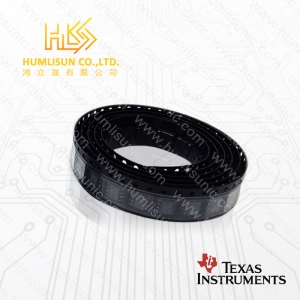
Data sheet Physical Mount Surface Mount Technical Max Operating Temperature 85 °C Min Operating Temperature -40 °C On-State Resistance 15 Ω Operating Supply Current 10 µA Throw Configuration SPDT Compliance RoHS Compliant SN74AUC2G53 SINGLE-POLE DOUBLE-THROW (SPDT) ANALOG SWITCH OR 2:1 ANALOG MULTIPLEXER/DEMULTIPLEXER This analog switch is operational at 0.8-V to 2.7-V VCC, but is designed specifically for 1.1-V to 2.7-V VCC operation. The SN74AUC2G53 can handle both analog and digital signals. The device permits signals with amplitudes of up to VCC (peak) to be transmitted in either direction.
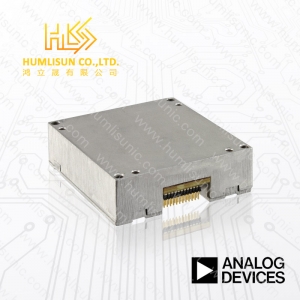
Data sheet Physical Case/Package Module Mount Panel Number of Pins 24 Technical -3db Bandwidth 330 Hz Max Operating Temperature 85 °C Max Supply Voltage 3.6 V Min Operating Temperature -40 °C Min Supply Voltage 3 V Nominal Supply Current 254 mA Operating Supply Current 254 mA Output Type SPI Sensor Type Accelerometer , Gyroscope , Magnetometer , 3 Axis Compliance Lead Free Contains Lead REACH SVHC No SVHC RoHS Compliant APPLICATIONS Platform stabilization and control Navigation Personnel tracking Instrumentation Robotics
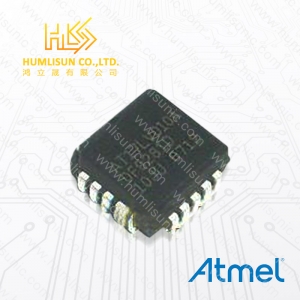
Data sheet Physical Number of Pins 8 Technical Frequency 15 MHz Max Operating Temperature 85 °C Max Supply Voltage 5.5 V Memory Size 1 Mb Memory Type EEPROM Min Operating Temperature -40 °C Min Supply Voltage 4.5 V Nominal Supply Current 10 mA Compliance Lead Free Contains Lead RoHS Compliant The AT17LV series FPGA Configuration EEPROMs (Configurators) provide an easyto-use, cost-effective configuration memory for Field Programmable Gate Arrays. The AT17LV series device is packaged in the 8-lead LAP, 8-lead PDIP, 8-lead SOIC, 20- lead PLCC, 20-lead SOIC, 44-lead PLCC and 44-lead TQFP, see Table 1-1. The AT17LV series Configurators uses a simple serial-access procedure to configure one or more FPGA devices. The user can select the polarity of the reset function by programming four EEPROM bytes. These devices also support a write-protection mechanism within its programming mode. The AT17LV series configurators can be programmed with industry-standard programmers, Atmel’s ATDH2200E Programming Kit or Atmel’s ATDH2225 ISP Cable.
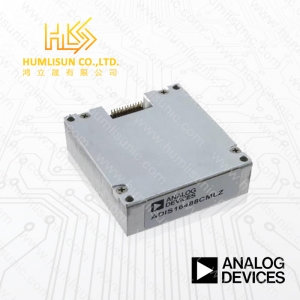
Data sheet Physical Number of Pins 20 Technical -3db Bandwidth 330 Hz Max Operating Temperature 85 °C Min Operating Temperature -40 °C Operating Supply Current 76 mA Output Type SPI Compliance RoHS Non-Compliant The ADIS16448 iSensor® device is a complete inertial system that includes a triaxial gyroscope, a triaxial accelerometer, a triaxial magnetometer, and pressure sensors. Each sensor in the ADIS16448 combines industry-leading iMEMS® technology with signal conditioning that optimizes dynamic performance. The factory calibration characterizes each sensor for sensitivity, bias, and alignment. As a result, each sensor has its own dynamic compensation formulas that provide accurate sensor measurements. The ADIS16448 provides a simple, cost-effective method for integrating accurate, multiaxis inertial sensing into industrial systems, especially when compared with the complexity and investment associated with discrete designs. All necessary motion testing and calibration are part of the production process at the factory, greatly reducing system integration time. Tight orthogonal alignment simplifies inertial frame alignment in navigation systems. The SPI and register structures provide a simple interface for data collection and configuration control. The ADIS16448 has a compatible pinout for systems that currently use other Analog Devices, Inc., IMU products, such as ADIS16334 or ADIS16485. The ADIS16448 is packaged in a module that is approximately 24.1 mm × 37.7 mm × 10.8 mm and has a standard connector interface. Applications Platform stabilization and control Navigation Robotics
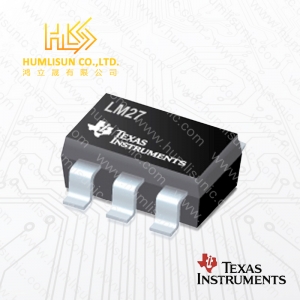
Date sheet Physical Case/Package Module Mount Surface Mount Number of Pins 24 Technical Max Operating Temperature 125 °C Min Operating Temperature -40 °C Operating Supply Current 3.6 mA Compliance RoHS Compliant IC TFT PANEL MODULE 24-LLP
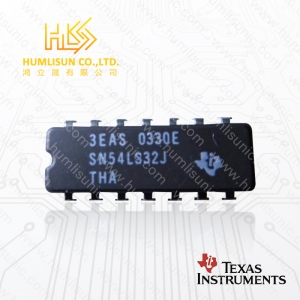
Data sheet Physical Case/Package CDIP Mount Through Hole Number of Pins 14 Technical High Level Output Current -400 µA Logic Function OR Low Level Output Current 4 mA Max Operating Temperature 125 °C Max Supply Voltage 5.5 V Min Operating Temperature -55 °C Min Supply Voltage 4.5 V Number of Bits 4 Number of Elements 4 Number of Gates 4 Number of Outputs 1 Operating Supply Voltage 5 V Output Type TTL Propagation Delay 22 ns Turn-On Delay Time 22 ns Compliance Lead Free Contains Lead Radiation Hardening No RoHS Compliant Quadruple 2-Input Positive-O Gates 14-CDIP -55 to 125
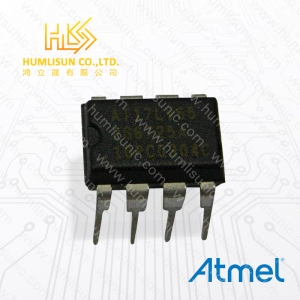
Data sheet Physical Case/Package PDIP Mount Through Hole Number of Pins 8 Technical Density 64 kb Frequency 12.5 MHz Interface Serial , 2-Wire Max Operating Temperature 85 °C Max Supply Voltage 5.5 V Memory Size 64 kb Memory Type EEPROM Min Operating Temperature -40 °C Min Supply Voltage 4.5 V The AT17LV series FPGA Configuration EEPROMs (Configurators) provide an easyto-use, cost-effective configuration memory for Field Programmable Gate Arrays. The AT17LV series device is packaged in the 8-lead LAP, 8-lead PDIP, 8-lead SOIC, 20- lead PLCC, 20-lead SOIC, 44-lead PLCC and 44-lead TQFP, see Table 1-1. The AT17LV series Configurators uses a simple serial-access procedure to configure one or more FPGA devices. The user can select the polarity of the reset function by programming four EEPROM bytes. These devices also support a write-protection mechanism within its programming mode.